Excellence isn’t about being the best. It’s about becoming better at something that matters to you.
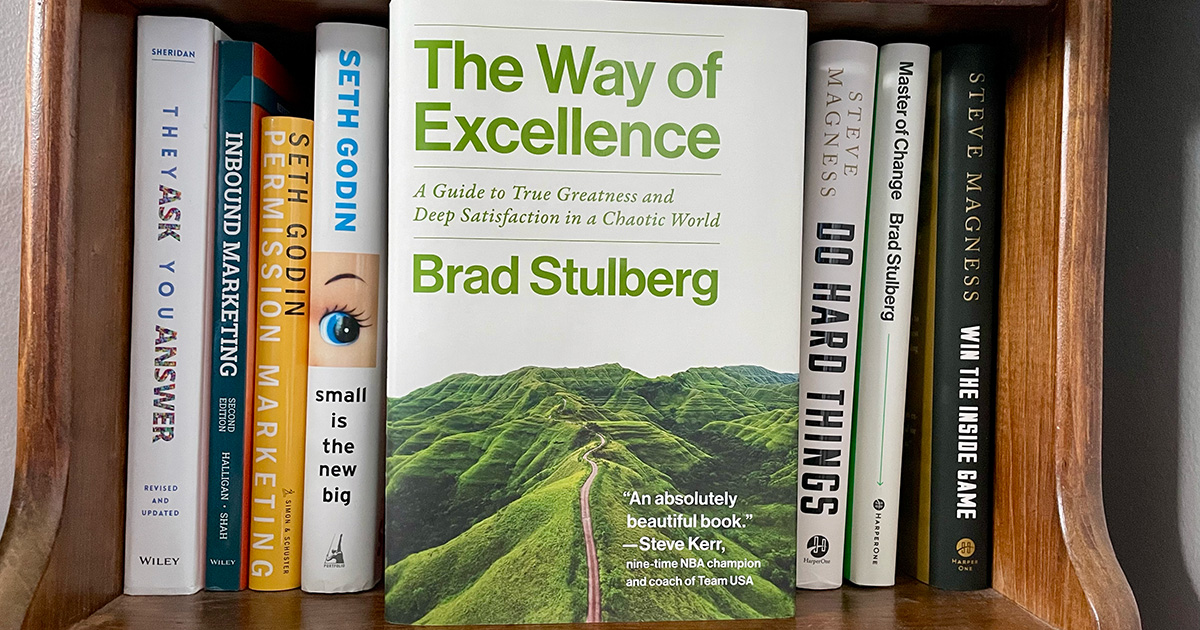
That’s one of the ideas I took away from Brad Stulberg’s The Way of Excellence, a book I recently finished that I think has something valuable to offer people in just about any pursuit.
As I read it, though, I kept finding myself translating Stulberg’s ideas into martial arts.
I’ve been practicing and teaching martial arts for a long time, and one of the things I appreciate about it is that there really isn’t a finish line. There’s always another technique to learn, another weakness to work on, another student to teach, another question to investigate.
So rather than give you a chapter-by-chapter review, I wanted to pull out five ideas that stood out to me as a martial artist and instructor.
What Is Excellence?
Before getting into those five ideas, it’s worth understanding what Stulberg means by excellence.
He defines it as:
“An ongoing process of growth and becoming that imbues life with meaning and vigor. It emerges from involved engagement in something worthwhile that supports your values and goals. Excellence combines mastery and mattering.”
I like that definition because it takes excellence out of the realm of trophies, awards, rankings, and accomplishments.
It’s a process.
And that’s a pretty good description of martial arts.
You don’t have to be naturally talented to practice martial arts. You don’t have to be the strongest, fastest, or most coordinated person in the room. The skills can be taught. The concepts can be learned. There’s no mysticism required.
But you do have to be involved.
You have to show up, pay attention, practice, ask questions, make mistakes, and keep going.
That brings me to the five ideas that stuck with me.
1. Excellence Requires Intimacy
Stulberg argues that you can develop a deep intimacy with an activity or craft.
He describes it as “a sense of familiarity, respect, and attention” that connects you to what you’re doing and to yourself. It requires minimizing distractions and getting as close as possible to your pursuit.
A few paragraphs later, he summed it up in a way that really stuck with me:
“Striving for excellence—doing real things, in the real world, with real results—keeps you grounded.”
This one hit home.
It’s incredibly easy to watch TV while scrolling on your phone. I do it while my wife and I watch TV. At best, I’m scrolling during the commercials. At worst, I’m supposed to be watching a show with her while escaping into whatever endless stream of content an algorithm has decided I should see.
(I actually felt compelled to check Instagram after typing that paragraph, so clearly I have some work to do here.)
Martial arts gives us a chance to step away from that.
For 60 or 90 minutes, your phone isn’t the important thing anymore. You’re on the floor. You’re moving. You’re paying attention to your body. You’re working with another person. You’re listening to an instructor.
You’re there.
That’s intimacy.
And the longer I practice, the more I realize that this is part of why martial arts matters to me. I’m not just striving to become a better martial artist. I’m striving to become a better teacher, student, and person. I think I can do that by spending less time doomscrolling and more time with real people.
2. Construct Your Identity House
Our identities are multifaceted.
I’m a dad and stepdad, a husband, a son, a brother, a teacher, an employee, a nonprofit board member, and more.
Stulberg compares our identity to a house.
If your entire identity is one room and something happens to that room, your whole house is in trouble. But if your identity has multiple rooms and one of them floods, you can find refuge in the others while you repair the damage.
The goal isn’t balance.
In fact, he says anybody pursuing excellence will be unbalanced. An Olympic athlete might reasonably spend an enormous amount of time in the “athlete” room for several years. That’s not necessarily unhealthy. The important thing is recognizing that the other rooms still exist, and knowing when you need them.
I think martial artists can understand this particularly well.
Martial arts can become a huge part of your identity. Your belt, your school, your instructor, your students, your competition record—all of those things can matter.
But they aren’t all of who you are.
And sometimes the size of that room changes.
There are periods when I’m training more and periods when I’m teaching more. There are times when karate takes up more space than tai chi chuan. There are times when work or family needs more of me than martial arts does.
That’s okay.
Martial arts has a room in our identity house.
It’s up to each of us to decide how big it needs to be right now.
3. Goals Should Reward The Process, Not Just The Outcome
Stulberg encourages us to focus on being the best at getting better rather than simply chasing a particular achievement.
A goal might be:
“I want to get my black belt.”
There’s nothing wrong with that goal. It’s a great one, actually.
But what happens when you get there?
I’ve watched students earn black belts and then quit. Sometimes life gets in the way. Some move away. Some go to college. Others simply see the black belt as the end of the journey.
But if your goal is something bigger than the belt, the belt isn’t the finish line.
A process-oriented goal might sound more like:
“I want to become the kind of person who continues to seek out martial arts knowledge.”
Now the black belt is part of the process rather than the destination.
Stulberg talks about “better” in terms of becoming stronger, kinder, and wiser.
That’s a much more interesting definition of progress than simply asking, “What belt am I?”
Because eventually, there is another belt.
And eventually, there isn’t.
What matters is what kind of person you became along the way.
4. Consistency Matters
One of Stulberg’s lines near the end of this chapter is:
“Nobody can become consistently great, but you can become great at consistency.”
That’s a concept I understand immediately as a martial artist.
You don’t need to have a great class every time.
You need to keep coming back.
For a student, that might mean getting to class once or twice a week and making the most of the time you’re there.
For me, it means making some sort of practice part of every day.
Sometimes that’s an hour of physical training, but sometimes it’s five minutes if I have a busy day.
Sometimes it’s mental practice—thinking through a technique, reviewing something I taught, or considering how I could explain a concept better next time.
The point isn’t that every practice session is great.
The point is that I consistently think about the practice.
And that consistency compounds.
Another area where consistency compounds: taking notes. If I can pick up one to three new ideas or techniques in a class, that compounds in a notebook over weeks, months, and years. I keep mine in Google Docs, but yours may be a notebook or something else.
Stulberg also talks about what he calls a “next-play mentality”: don’t let the last play determine the next one.
That’s useful advice outside of martial arts, too.
If you’re having a great day, enjoy it, but don’t become complacent.
If you’re having a terrible day, don’t let one bad moment become the entire day.
I’m pretty aware when I’m in a bad mood. And usually, I’m also aware that I don’t particularly want to be in a bad mood.
So sometimes the goal isn’t to turn the whole day around, but to just salvage the next hour.
Maybe I go to class. Maybe I practice for five minutes. Maybe I have a good conversation with my wife. Maybe I go to bed feeling like I recovered a little bit of the evening.
That’s consistency, too.
Not perfection. Just the next play.
5. Embrace The “Brave New World”
Martial arts constantly puts us in situations where we don’t know exactly what’s going to happen next.
A new belt, a new form, a new responsibility in class, a new tournament, or a new student.
Stulberg suggests meeting the unknown with curiosity rather than fear.
He writes about becoming less concerned with what could happen and more interested in finding out what will happen.
I think that’s perfect for martial arts.
The dojo is a relatively safe place to practice being uncomfortable.
You can learn a new technique and be terrible at it.
You can get paired with someone you’ve never worked with.
You can compete against someone you’ve never met.
You can stand in front of a class and teach something for the first time.
Those experiences can be awkward. Sometimes they’re humbling.
But you figure them out.
As a practitioner, I’m constantly exposed to things I don’t know. As an instructor, I’m constantly exposed to situations I haven’t taught before.
If I were afraid of learning something new, I’d never progress.
If I were afraid of working with a new student, I’d never grow as an instructor.
And if I were afraid of every unknown situation, I’d miss a lot of the things that make martial arts interesting in the first place.
That’s one of the reasons I value martial arts beyond its physical benefits.
It gives us a place to practice curiosity.
And hopefully, if we ever find ourselves in a situation where we genuinely need to protect ourselves or someone we love, we can respond from training and judgment rather than panic.
A Martial Artist’s Pushback
There is one point in the book where I disagree with Stulberg, and it comes up in the discussion about presence.
Stulberg makes the case for leaving your phone behind during some everyday activities—a hike, for example, or a trip to the grocery store. I understand the argument. Our phones are distractions, and constantly having one within reach makes it harder to be present, patient, and engaged with the world around us.
But from a martial arts and self-defense perspective, I don’t think the answer is to leave the phone behind.
What happens if you trip on a hike, break your leg, and can’t walk?
Or what happens if you walk out of a grocery store at night and notice someone rummaging around your car?
(I know, I’ve become the “what if…?” guy here)
That second scenario was actually described to me at a martial arts seminar several years ago—a martial artist found someone suspicious in or near their car during an after-dark grocery run. This person handled it differently than I would’ve. Instead of confronting the person, I would’ve used my phone to call the police, and/or alerted store staff to the activity in the parking lot.
That’s a pretty important distinction.
Being present doesn’t mean being unprepared.
As martial artists, we spend a lot of time thinking about awareness, avoidance, and having options when something goes wrong. A phone is one of those options. In some situations, having it available can be far more valuable than the small benefit I’d get from practicing patience without it.
I understand what Stulberg argues for. There is value in putting the phone down and being present with the world around us. I probably need more of that.
But I don’t think I need to leave my phone in the car to accomplish it.
For me, the risk of not having a phone when I genuinely need one outweighs the reward of practicing patience without it.
Excellence Is Built From Small Things
The full book is worth reading, but I wanted to highlight what Stulberg says makes up excellence.
His table of contents includes:
- Care
- Goals
- Consistency
- Trade-offs
- Focus
- Discipline
- Renewal
- Confidence
- Patience
- Routine
- Gumption
- Curiosity
- Failure
- Community
- Joy
- Completion
That’s a pretty good set of ideas for a martial artist.
And maybe that’s the biggest thing I took away from The Way of Excellence.
Excellence isn’t some extraordinary state reserved for elite athletes, artists, entrepreneurs, or martial artists.
It’s built out of ordinary things done consistently.
Showing up. Paying attention. Being curious. Getting uncomfortable. Failing. Trying again. Helping somebody else. And continuing to learn.
You don’t have to be a great martial artist to pursue excellence. You just have to care enough to keep getting better.
If you seriously practice martial arts—or you’re thinking about starting—I think this book is worth your time.